Update on HUD Program Funding
Jessilyn Averill
Earlier this month on June 1, the U.S. Department of Housing and Urban Development (HUD) released the FY2026 Continuum of Care (CoC) Competition and Youth Homelessness Demonstration Program Grants Notice of Funding Opportunity (NOFO), which will provide homeless assistance funding to renewal and new grants beginning in 2027. The CoC funding currently provides over $7M in funding to the Washtenaw County CoC and supports grants to five agencies: Avalon Housing; Michigan Ability Partners; Ozone House; SOS Community Services; and, Washtenaw County Office of Community & Economic Development (OCED).
94% of the HUD CoC Program funding is used locally to support permanent housing programs, which pay for rental assistance and supportive services costs. The programs currently funded are a Rapid Re-Housing (RRH) grant for families and many Permanent Supportive Housing (PSH) grants for individuals, families, and young adults. The permanent housing programs are currently designed to help people end their homelessness as quickly as possible and move towards self-sufficiency and a better quality of life with the assistance of wraparound supports. In addition, the CoC funding currently supports two system infrastructure grants: a Homeless Management Information System (HMIS) grant and a CoC Planning grant, both of which are operated by Washtenaw County OCED.
Note that, by law, the HUD CoC program cannot fund emergency shelter or eviction prevention programs; there is another HUD program, the Emergency Solutions Grants (ESG) Program, that can support these program types.
The FY2026 CoC NOFO is a move away from the long-standing “Housing First” model, which emphasizes providing affordable housing first to people experiencing homelessness and then providing wraparound services, toward a model that prioritizes treatment, recovery, and transitional housing instead of permanent housing. HUD describes FY2026 as a major policy realignment rather than a routine competition.
In previous HUD CoC funding competitions, 90% of a community’s CoC Program funding was mostly guaranteed; in the FY2026 NOFO, only 60% of the community’s funding is mostly guaranteed (placed in Tier 1 of a ranked project listing in the community’s application to HUD). For FY2026, Permanent Housing funding will be limited relative to prior years and there is greater competition – across the country – for renewal dollars than in previous years, which may jeopardize the stable – but relatively flat – resources of homeless response systems nationwide, including in Washtenaw County. The National Alliance to End Homelessness (NAEH) predicts that the funding competition changes threaten to put more than 97,000 formerly homeless people [nationwide], including families with children, those with disabilities, older adults, and veterans, at risk of losing their permanent housing. Read NAEH’s detailed analysis of the FY2026 CoC NOFO here.
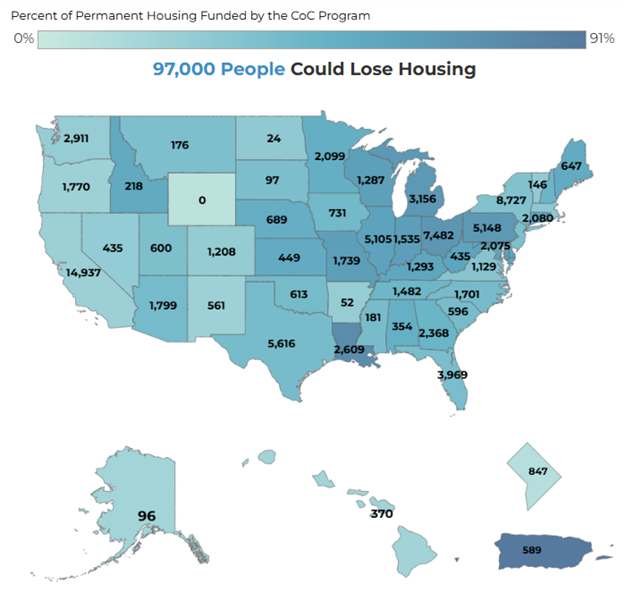
Above is a map showing how many people could lose housing in every state should the FY2026 NOFO change and/or cut permanent housing funding in the CoC Program. This map is interactive on NAEH’s website. Check it out at endhomelessness.org/resources/hud-policy-changes-threaten-efforts-to-end-homelessness
While our community and partners were expecting some of these changes, based on previously released and litigated NOFO versions from the fall of 2025 (read more about that on our blog), this competition requires us and communities across the country to reorient their systems of care to transitional housing solutions and services focused on self-sufficiency, recovery, and public safety. This competition is an opportunity for the local CoC Board, partners, service providers, and funders to come together and collaborate to identify alternative resources for permanent housing programs that are needed but will ultimately lose funding through the HUD CoC program. There is also an opportunity to put forward new projects that support gaps in the current system of care.
The Washtenaw County CoC is now trying to respond to these changes and is expected to release a local funding application very soon. The local funding competition will occur over the next two months. Currently funded providers may seek to maintain their permanent housing programs as-is or convert to a transitional housing or supportive services only program model type. New agencies will be able to also apply for new projects that align with the FY2026 NOFO. The Washtenaw County CoC’s application to HUD must be submitted by August 26, 2026, and FY2026 CoC grant awards should be announced by HUD in December 2026.
This timeline – or the FY2026 CoC funding competition itself – could be interrupted by a recently filed lawsuit from national homeless advocates and partners. The NAEH joined a coalition of co-plaintiffs to file suit against HUD. This legal action, titled National Alliance to End Homelessness v. United States Department of Housing and Urban Development, was filed in the U.S. District Court for the District of Rhode Island and seeks to block what is described as, “…unlawful program disruptions” before they take effect. Read the press release from NAEH’s representative Democracy Forward for more information.
Persistent attempts by HUD to implement policy and funding changes that undermine permanent housing and evidence-based solutions like Housing First will continue to impact how communities like ours can support those experiencing or at-risk of homelessness. We are grateful to the local and state partners who are providing support and direct funds to fill in gaps left from potential federal cuts and we are grateful to the national partners for once again using the courts to hold HUD accountable. Our focus now must be on responding to the federal funding and policy shifts to fill gaps in our system of care and preserving permanent housing as much as possible using other more local and flexible resources.